Kuakata's Zone Kuakata Beach Kuakata is a town in southern Bangladesh known for its panoramic sea beach. Kuakata beach is a sandy expanse 18 kilometres (11 mi) long and 3 kilometres (1.9 mi) wide. From the beach one can have an unobstructed view of both sunrise and sunset over the Bay of Bengal. Etymology The name Kuakata originated from the word 'kua' — the Bengali word for "well" which was dug on the seashore by the early Rakhine settlers(Burmese tribes) in quest of collecting drinking water. They landed on the Kuakata coast in the 18th century after being expelled from Arakan (Myanmar) by the Burmese extremests . Afterwards, it has become a tradition of digging wells in the neighbourhoods of Rakhaine tribes for water. Geography Kuakata is in Kalapara Upazila, Patuakhali District. It is about 320 kilometres (200 mi) south of Dhaka, the capital, and about 70 kilometres (43 mi) from ...
Get link
Facebook
X
Pinterest
Email
Other Apps
Top Places to Visit in Sundarbans
Get link
Facebook
X
Pinterest
Email
Other Apps
-
The Sundarbans (Bengali: romanized: Shundorbôn, lit.
‘Beautiful forest’, Bengali pronunciation: [ˈʃundorbɔn]) is a mangrove area in
the delta formed by the confluence of Ganges, Brahmaputra and Meghna Rivers in
the Bay of Bengal. It spans from the Hooghly River in India’s state of West
Bengal to the Baleswar River in Bangladesh. It comprises closed and open
mangrove forests, agriculturally used land, mudflats and barren land, and is
intersected by multiple tidal streams and channels. Four protected areas in the
Sundarbans are enlisted as UNESCO World Heritage Sites, viz Sundarbans National
Park, Sundarbans West, Sundarbans South and Sundarbans East Wildlife
Sanctuaries.
The Sundarbans mangrove forest covers an area of about
10,000 km2 (3,900 sq mi). Of which, forests in Bangladesh’s Khulna Division
extend over 6,017 km2 (2,323 sq mi) and in West Bengal, they extend over 4,260
km2 (1,640 sq mi) across the South 24 Parganas and North 24 Parganas districts.
The most abundant tree species are Sundri (Heritiera fomes) and Gewa
(Excoecaria agallocha). The forests provide habitat to 453 faunal wildlife,
including 290 bird, 120 fish, 42 mammal, 35 reptile and eight amphibian species.
Despite a total ban on all killing or capture of wildlife
other than fish and some invertebrates, it appears that there is a consistent
pattern of depleted biodiversity or loss of species in the 20th century, and
that the ecological quality of the forest is declining. The Directorate of
Forest is responsible for the administration and management of Sundarban
National Park in West Bengal. In Bangladesh, a new Forest Circle was created in
1993 to preserve the forest, and Chief Conservators of Forests have been posted
since. Despite preservation commitments from both Governments, the Sunderbans
are under threat from both natural and human-made causes. In 2007, the landfall
of Cyclone Sidr damaged around 40% of the Sundarbans. The forest is also
suffering from increased salinity due to rising sea levels and reduced
freshwater supply. Again in May 2009 Cyclone Aila devastated Sundarban with
massive casualties. According to news paper source at least 1 lakh people were
affected by this cyclone. The proposed coal-fired Rampal power station situated
14 km (8.7 mi) north of the Sundarbans at Rampal Upazila of Bagerhat District
in Khulna, Bangladesh, is anticipated to further damage this unique mangrove
forest according to a 2016 report by UNESCO.
1. Sudhanyakhali
Watch Tower
If “All Along the Watchtower” popped immediately into your
mind when you read this headline, you’re the person I’m speaking to. Playing
along the track on your tranquil vacay, you could climb the Sudhanyakhali
watchtower to spot tigers in your vicinity. This is the most opportune place to
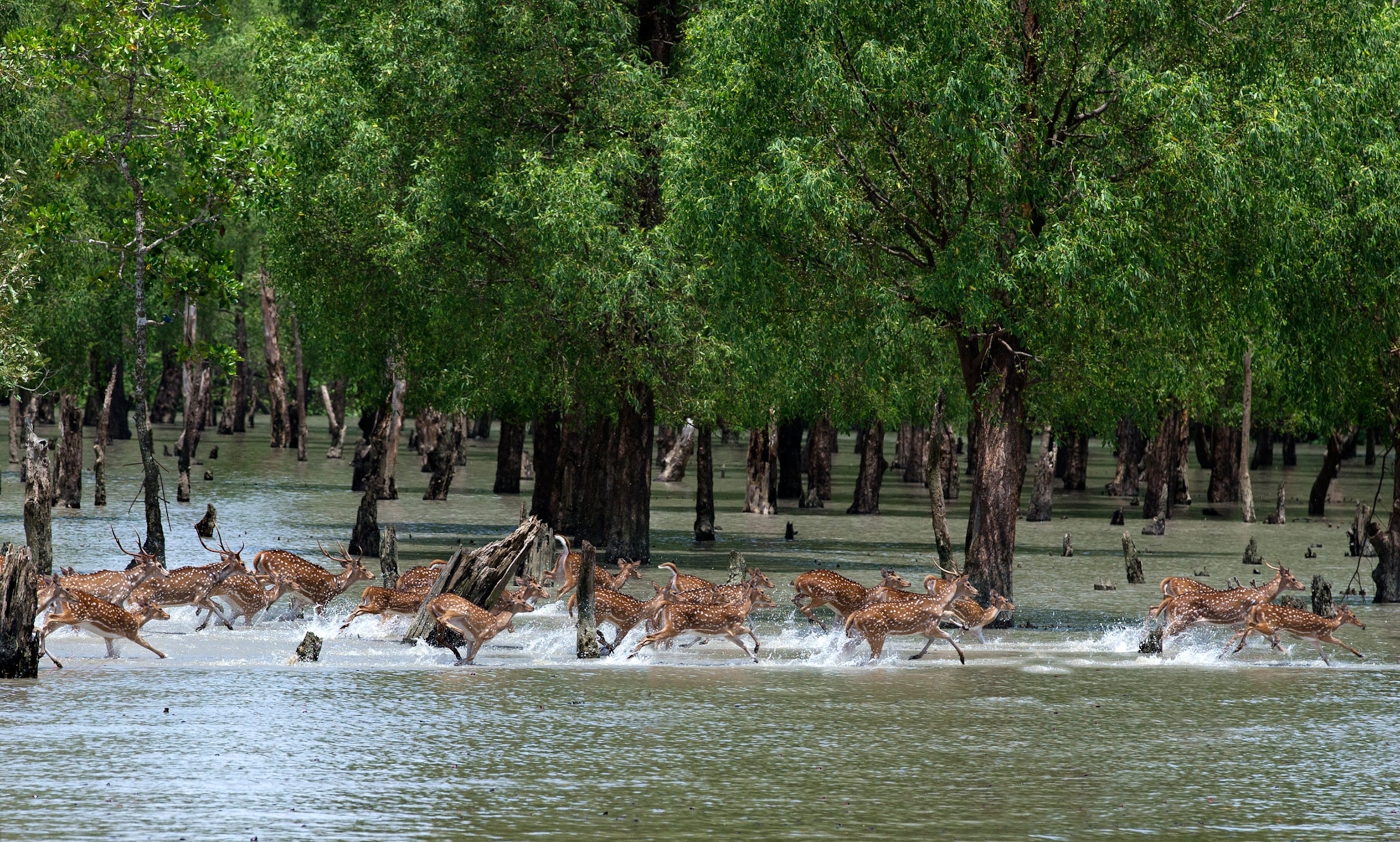
watch tigers from, the highlight of the Sunderbans. Also visible, with luck of
course, are axis deer and the like. An added bonus is the charming vista full
of trees and greenery you get to see for miles all around when up high on this
vacation must-visit.
2. Sajnekhali Watch
Tower
Sajnekhali Watch Tower is the second most important
watchtower in the Sunderbans tower. It provides all the mojo of other towers
plus much more. It is the place where you can spot the famous tiger species,
and also the place to watch pretty gruesome crocodiles in live action. There is
also opportunity to indulge your excited wildlife enthusiast touristy curiosity
in a museum and crocodile park within the premises, which showcases a
collection of exquisite details. There’s also a temple within the grounds,
traditional style, a Bonobibi temple.
3. Netidhopani
Netidhopani one is a complete tourist destination package of
Sunderbans. This has a lake famous for being picturesque to look at and click
pictures of, and also a ground that houses ruins of ancient buildings that once
were. More precisely, there are ruins here of a temple that’s old four times as
much as a century, and has achieved almost pilgrimage status with the sheer
number of people who visit it to worship and pay homage. This place also has
pop tourist apparatus like hotels. So in case you were thinking Sunderbans was
all about tigers, think again.
4. Sunderbans
National Park
Sunderbans are the most famous for its wildlife treasures it
presents to tourists, and this spot is the collective inventory of the best
among the rest in terms of wildlife. It is a place where land dissolves into
water, and is known principally for its wide and eye catching reserves of tiger
and birds, both parks of which are built around this area as the centre. It is
located southmost of Bengal, and is one of the highlights of Sunderban tourism.
It achieved such status in the late 1900s.
5. Sajnekhali Bird
Sanctuary
This, along with the tiger reserve of Sunderbans, are the
main crowning jewels of, glistening feathers in, Sunderbans’ cap. This is the
ideal place where you can go for a walk through if you’re here on vacation.
You’d get lovely views of the Peechkali and the Gomti. The highlighted bird
species here are those of egrets, herons and the like. Also, this place is
hygienic and the sir healthy for you, along with being eco friendly. Sajnekhali
Bird Sanctuary is situated right near to its sibling animal reserve, the lordly
Tiger Reserve.
Sunderbans in West Bengal are the most green, clean and
offbeat tourist destination in the nearabouts by a mile. And it is all of those
things for good reasons, too. It is green wherever you look at it, shaded by
gigantic trees. It is clean and refreshing, you understand that part as soon as
you breathe. And it is marvellously offbeat and wonderful because its not every
tourist spot that can offer tigers and watchtowers over forests instead of
nightclubs, and kudos to you for being one amazing unconventional traveller
too.
The main gate of Historical shat Gombuj Mosque. Situated in the suburbs of Bagerhat, at the meeting-point of the Ganges and Brahmaputra rivers, this ancient city, formerly known as Khalifatabad, was founded by the Turkish general Ulugh Khan Jahan in the 15th century. The city’s infrastructure reveals considerable technical skill and an exceptional number of mosques and early Islamic monuments, many built of brick, can be seen there. Outstanding Universal Value Brief synthesis The Historic Mosque City of Bagerhat is an important evidence of medieval city in the south-west part of present Bagerhat district which is located in the south-west part of Bangladesh, at the meeting-point of the Ganges and Brahmaputra rivers. The ancient city, formerly known as Khalifatabad, sprawls over on the southern bank of the old river Bhairab and flourished in the 15th century BC. The magnificent city, which extended for 50 km2, contains some of the most significant buildings of the initial period o...
Rangamati Hill District Rangamati Hill District, is a district in south-eastern Bangladesh. It is a part of the Chittagong Division and the town of Rangamati serves as the headquarters of the district. By area, Rangamati is the largest district of the country. History Rangamati was a contesting ground for the kings of Tripura and Arakan.It was known as Reang/Riang Country before East India Company came. This region came under the Mughal Empire after the Muslim invasion in 1566. In 1737, Sher Mosta Khan, a tribal leader, took refuge with the Mughals. After this the Chakma settlement began along with various other settlements of varying ethnicity. From 1760 to 1761, this land was leased to the East India Company. Demography The total population is 508,182 according to 2005 census of which indigenous communities constitute 52% and non-indigenous Bengalis constitute 48%. The number of males is 287,060 and ...



Comments
Post a Comment